If you asked 10 people to find what they thought the most important technological advancement in ancient times was, you would probably get responses like the wheel, writing, or the plough. Rarely would anyone mention iron. Yet it quietly revolutionised everyday life more than almost anything else. Although it wasn’t the first metal humans used, nor was it the best for a long time. However, it was abundant, and once people had mastered how to work with it, metal tools were no longer a luxury to kings and armies but were used by everyone on their farms and in their workshops.
This guide covers what the Iron Age was, when it happened, how iron was made without modern technology, and what actually changed. It also helps resolve some common misunderstandings, such as why searching for the term can sometimes take you to a restaurant!
What Was the Iron Age?
The Iron Age refers to a time in human history when iron became the primary resource used for tools and weapons in a particular society. The Iron Age follows on from the Bronze Age and is the final section of the three periods known as the ‘three-age system’, still used today by archaeologists.
This system was developed by a Danish scholar named Christian Jürgensen Thomsen in the early 19 th century. He classified artefacts in museums into the Stone, Bronze and Iron Ages. This became a way to categorise artefacts but also developed into a way of thinking.
Some key points you should know:
- It refers to the technological advances of a society. This does not refer to one civilisation. People during the Iron Age lived in very different ways. Some were city dwellers such as the Assyrians, whilst others were farmers such as the Celts living in hillforts.
- It is not an exact division. People did not stop using bronze completely. They continued to use it in jewellery, ornaments, bells, and many tools.
Iron Age: When Did It Happen?
The honest answer is that it depends on where you look. Iron technology did not spread from one source like a switch being flipped. Different regions adopted it at different times, and some developed it independently or adapted it in their own way. The dates below are approximate and vary between scholars, so treat them as ranges.
| Region | Rough start of the Iron Age | Notes |
| Eastern Mediterranean and Near East | Around 1200 to 1000 BCE | Follows the unrest at the end of the Late Bronze Age |
| South Asia | Around 1200 to 1000 BCE | Iron appears in several regional cultures |
| Central and Western Europe | Around 800 to 700 BCE | Often divided into Hallstatt and La Tène phases |
| Britain | Around 800 BCE | Traditionally runs until the Roman conquest beginning in 43 CE |
| China | Around the 8th to 5th century BCE | Cast iron appears early and is used at scale |
| Parts of Africa | Roughly 1000 to 500 BCE onward | Varies widely, with notable ironworking in the Nok culture and at Meroë |
| Japan | Around 300 BCE | Associated with the Yayoi period |
| The Americas | Not applicable before European contact | No native iron smelting tradition is known |
If you want a single-sentence answer to “iron age when,” it is this: the Near East entered it around 1200 BCE, much of Europe a few centuries later, and the end date depends on when a region’s written history, Roman rule, or another major shift takes over. In Britain, for example, the Roman invasion is the conventional endpoint. In the Near East, historians often shift to terms like the Neo-Assyrian or Persian periods instead.
Why Iron Became Important
Iron everywhere, but tin nowhere!
Bronze is created from copper and (typically) tin. There is little tin available, and it isn’t evenly distributed. This meant that bronze could involve lengthy trading. However, iron ores are found in lots of places across the world. They can be found in bogs and on the surface.
Some historians think iron became popular due to disruption of the Bronze Age trade routes around the end of the second millennium BCE. This is debatable. In truth, there are many factors, and to read more about this, you can look at our guide to [INTERNAL TOPIC: the Late Bronze Age collapse]. There are many theories.
Early iron wasn’t necessarily better.
This often comes as a surprise to many people. High-quality bronze can be hard. Early iron was quite soft and inconsistent, meaning it wasn’t always better. However, once more advanced techniques were used, such as adding carbon to create steel and then hardening it using heat and fast cooling,, the iron became much better. Skilled blacksmiths learned how to do this through experience, without knowing any chemistry.
It wasn’t that iron was a miracle material; it was more affordable, readily available, and became very good in skilled hands.
How Iron Was Made Without Modern Technology
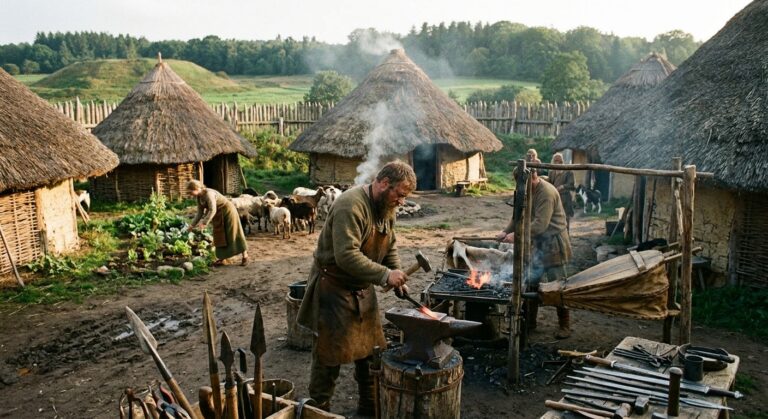
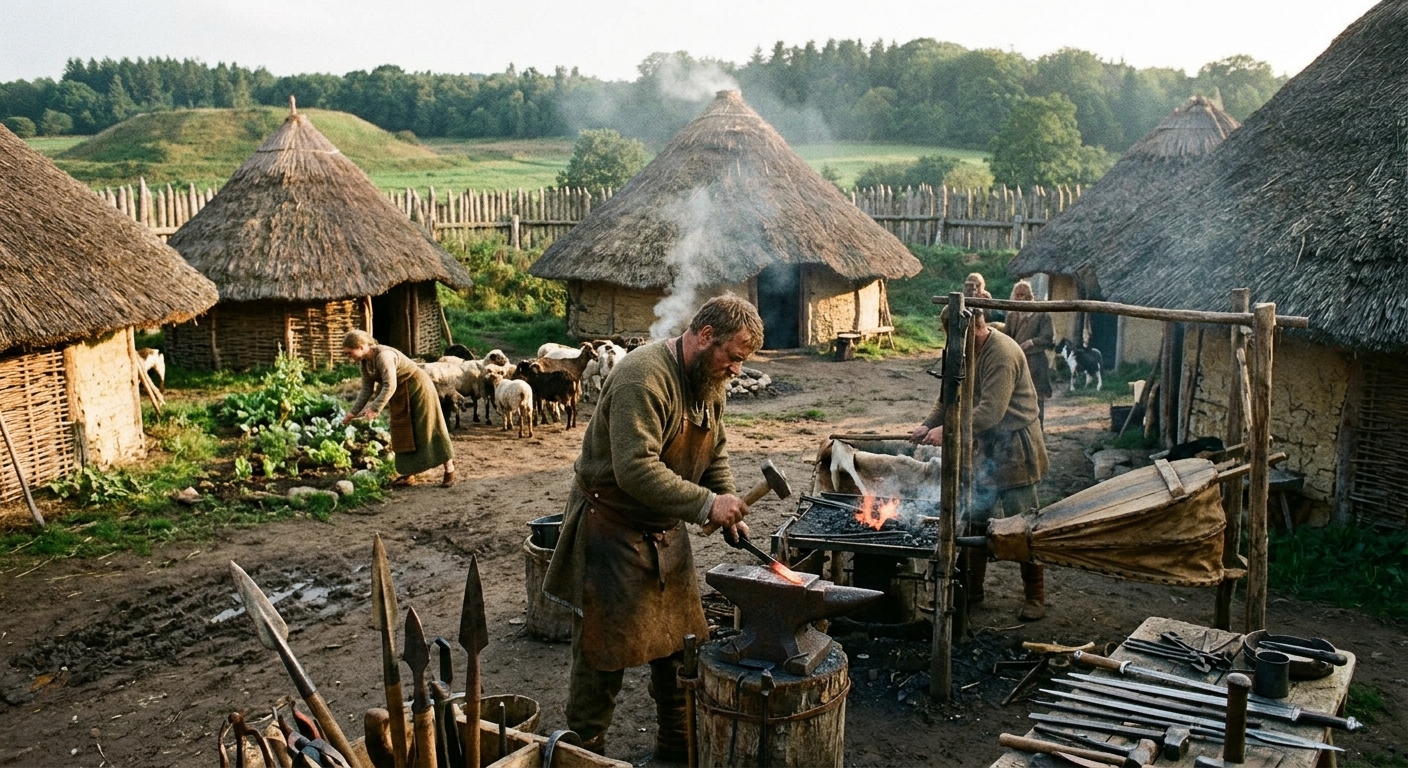
The majority of early iron was produced using a process known as bloomery smelting. This involved;
- Mining and preparing the ore. The ore would be mined and then crushed and sometimes roasted.
- Creating an oven. The ‘oven’ would typically be a clay chamber or hole. Charcoal and ore would then be placed inside.
- Air would then be forced in. Using bellows or natural air currents, the temperature increases.
- The ore would be reduced. Carbon monoxide from burned charcoal would remove oxygen from the iron oxide.
- A spongy mass of iron and slag would form (known as the bloom).
- This would then be hammered. The bloom would be heated and then hammered to force the slag out, creating a usable bar of iron. These ovens typically wouldn’t reach the high temperatures required to completely melt pure iron, so early iron was hammered into shape (wrought iron) as opposed to being cast into shapes like bronze.
However, China was notable for learning how to create cast iron. As the higher carbon content in iron means it can melt at a lower temperature, this allowed them to cast their iron. This allowed them to use moulds to create tools, etc. In later centuries, China found iron production using state-run methods became economically important. However, for specifics and dates, it is best to look into a specialist source.
Read More: The Age of Adaline: A Timeless Love Story
How Iron Changed Daily Life
Agriculture
The introduction of iron axes, sickles, and plowshares made clearing woodland and loosening hard soil much easier. As iron tools became cheaper, more families were able to purchase them. This led to increased harvests and population growth in many areas over time. Although not immediate, iron did make the agriculture industry expand easier.
Military
More iron weapons and armour were produced. The Neo Assyrian Empire is often cited for having large and well-armed armies. However, other factors were involved here such as organisation, supplies, siege tactics and political structure. It did help, though.
Craft and Trade
As iron was readily available, there were more smiths in each community. Bars of iron were sometimes used as standardised wealth. Archaeological evidence shows that bars were found in some areas that would seem to be used as a currency. New types of building and shipbuilding became more practical through the use of weapons, tools, nails and fittings.
Society
As basic tools became more affordable, the elite needed to change how they showed their status. In many areas there was a shift to using high-quality swords, decorated metalwork, feasting equipment, and large sites. It wasn’t always the case, and it can be risky to say that iron democratized society.
Iron Age Societies Worth Knowing About
Iron Age Britain:
- A famous period of history known for its hill forts, circular houses and localised communities. An example of a famous hill fort would be Maiden Castle in Dorset.
Hallstatt and La Tène cultures:
- These cultures were named after archaeological sites in Austria and Switzerland. They are often associated with the early Celts; however, modern historians are wary of labelling them like this.
Nok culture:
- A culture famous for its terracotta statues and early iron smelting techniques in present-day Nigeria.
Meroë:
- An important centre of the kingdom of Kush. It has been heavily associated with iron.
Early Chinese states:
- They are famous for their cast iron techniques that were developed during the Eastern Zhou period and later increased.
Common Mistakes When Thinking About the Iron Age
- Assuming one global start date. The Iron Age is a regional concept.
- Treating it as “primitive.” Iron Age societies built roads, trade systems, fortified towns, and sophisticated metalwork.
- Thinking iron replaced bronze overnight. Both metals coexisted for centuries.
- Assuming all iron was strong. Quality varied with ore, fuel, and smith skill.
- Mixing up the Iron Age with the Middle Ages. In much of Europe, the Iron Age ended with Roman expansion, long before the medieval period.
A Quick Note on “Iron Age Korean Steak House”
If you arrived here from a search for Iron Age Korean Steak House, that is a restaurant name and has no connection to ancient history. The name appears to be a play on the idea of cooking over hot metal. Restaurant details such as locations, hours, menus, and pricing change often, so please confirm them through the restaurant’s official website or a current map listing before you go.
Practical Ways to Explore the Iron Age Yourself
You don’t need to be an academic to get involved!
- Visiting museums: There are lots of national and local museums that have Iron Age artefacts on display. Find out what they have in their collection beforehand.
- Look out for places that re-create Iron Age sites. Many heritage parks will have roundhouses and smelting demonstrations. Hours and activities can vary, so find out what they have.
- Sometimes people will build up bloomery furnaces to test out ancient methods. This is called experimental archaeology.
- Find out about local history. If you live in Europe, you might have a hill fort or burial mound nearby that has local interpretation.
Key Takeaways
- The Iron Age is a technological label, and its dates change by region, starting around 1200 BCE in the Near East and later elsewhere.
- Iron mattered mostly because ore was widely available, not because early iron was always superior to bronze.
- Bloomery smelting produced workable iron through hammering, while Chinese smiths developed large-scale cast iron.
- The effects on farming, war, trade, and status were real but varied, and no single factor explains them.
- If you were searching for the restaurant, verify its current details through official sources.
Frequently Asked Questions (FAQs)
When did the Iron Age start and end?
It started around 1200 BCE in parts of the Near East and later in other regions. The end is defined differently depending on place, often by the arrival of Roman rule or the rise of historical records.
Did the Iron Age come after the Bronze Age?
In regions where the three-age model applies, yes. But the transition was gradual and uneven.
Why is it called the Iron Age?
Because iron became the main material for tools and weapons, as described in the framework developed in the early 1800s.
Was iron stronger than bronze?
Not always. Steel made from properly worked iron could be stronger, but quality depended heavily on the smith’s technique.
About the Author