Imagine a puzzle coming together too quickly, pieces fusing before they’re meant to fit. This is what happens in Pfeiffer syndrome, a rare genetic condition where skull bones lock together prematurely, reshaping a child’s developing head and face in profound ways. Discovered by German geneticist Rudolf Arthur Pfeiffer in 1964, this disorder affects roughly 1 in 100,000 births, making each case a unique medical journey.
The Genetic Story
When parents receive this diagnosis, the first thing they want is more pfeiffer syndrome information. At the heart of Pfeiffer syndrome lies a microscopic miscommunication. Mutations in either the FGFR1 or FGFR2 genes, which encode the body’s blueprint for fibroblast growth factor receptors, send faulty signals during development. These receptors normally act as careful conductors, orchestrating when cells should mature into bone. When mutated, they’re like an overeager conductor, rushing the performance and telling cells to transform into bone far too early.
Skull bones that should remain separate and flexible during infancy instead fuse, while bones in the hands and feet develop their own distinctive abnormalities. While the condition can be inherited, most children with Pfeiffer syndrome are the first in their family to have it, the mutation arising spontaneously, often linked to older fathers at the time of conception.
Three Faces of One Syndrome
Pfeiffer syndrome doesn’t present itself uniformly. Think of it as existing along a spectrum of severity, formally divided into three types that tell very different stories.
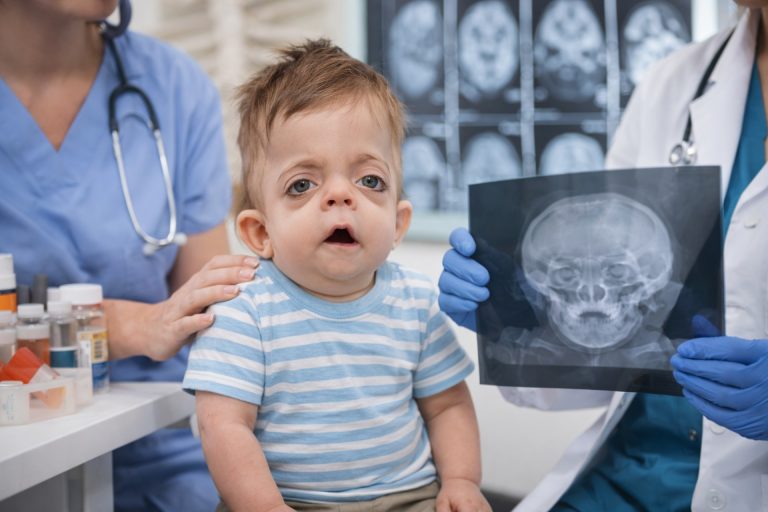
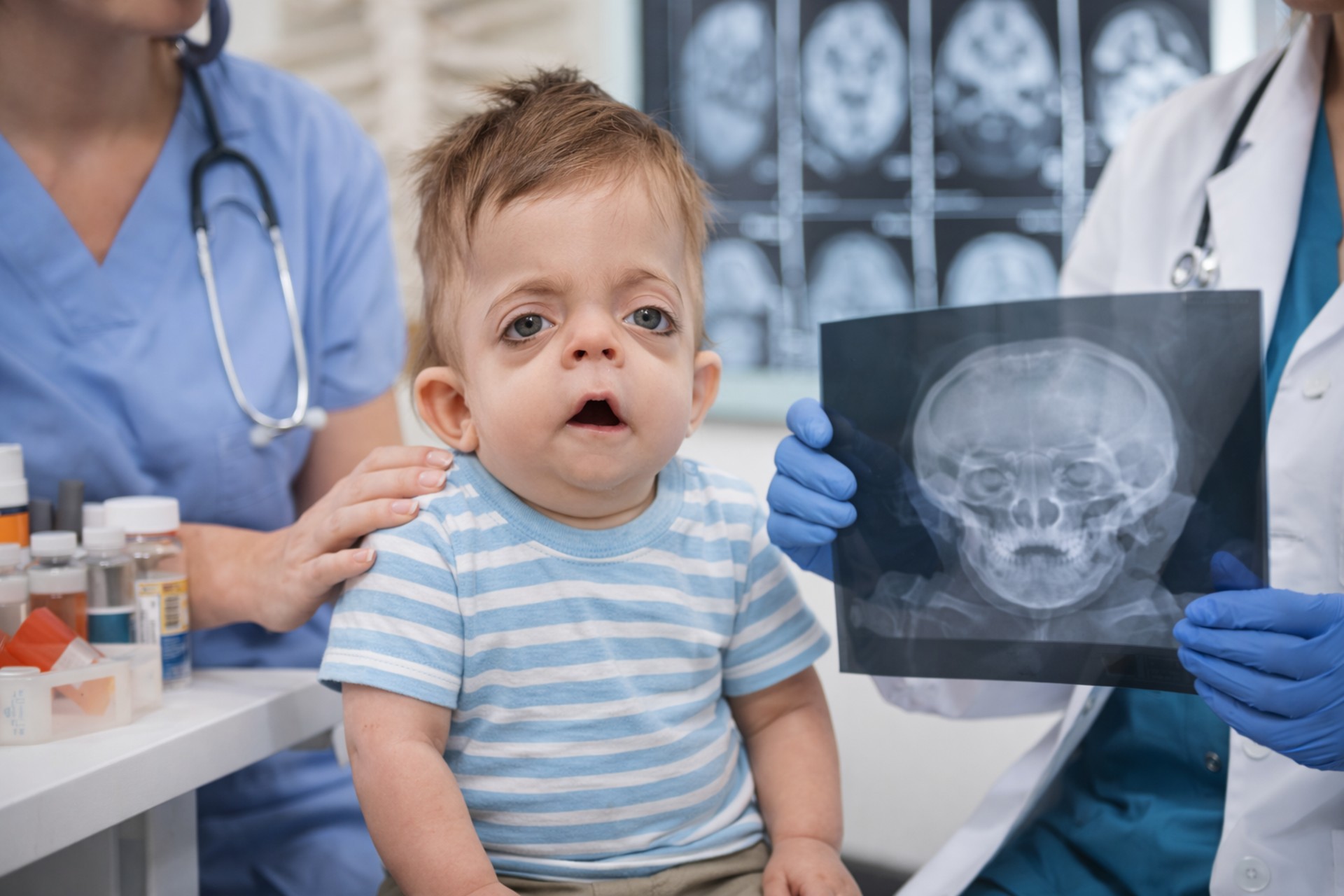
Type 1, the most common and mildest form, allows children to lead relatively normal lives. These individuals typically have normal intelligence and lifespan. However, their appearance is distinctive: wide-set, prominent eyes that bulge slightly forward, a sunken midface, and a nose with a beak-like quality. Their heads may have an unusual, tower-like or triangular shape, with bones having fused prematurely.
Types 2 and 3 paint a more challenging picture. Type 2 creates a dramatic “cloverleaf skull”—named for its trefoil shape visible on imaging—with severe eye protrusion and profound developmental concerns. Type 3 shares the severity without the cloverleaf formation. Both carry sobering prognoses, with significant neurological complications and shortened life expectancy casting long shadows over affected families.
Across all types, one feature remains constant: distinctively broad thumbs and big toes that angle away from the other digits, as if perpetually hitchhiking. Sometimes fingers or toes fuse, creating a webbed appearance that makes these extremities instantly recognizable to specialists.
The Hidden Dangers
Beyond the visible differences lies a cascade of potential complications. When skull bones fuse too early, the growing brain can be trapped in a container that’s too small, like trying to inflate a balloon inside a box. This increased intracranial pressure can trigger headaches, vision problems, and developmental delays if not addressed surgically.
Breathing becomes a nightly battle for many. An underdeveloped midface can obstruct the airways, leading to sleep apnea, in which breathing repeatedly stops during sleep. Parents become vigilant nighttime sentinels, monitoring their children’s breathing patterns. Hearing often suffers too, whether from structural ear abnormalities or nerve damage, potentially affecting speech and language development.
The protruding eyes, medically termed proptosis, leave the corneas constantly exposed to air, vulnerable to drying and damage. Some children experience double vision or struggle with eye coordination, their visual world literally skewed by their condition.
A Team Effort
Diagnosing Pfeiffer syndrome often happens in the delivery room, where characteristic features immediately catch a pediatrician’s eye. Genetic testing confirms suspicions by pinpointing the culprit mutations, while CT scans reveal the hidden architecture of fused bones and misshapen structures.
Treatment becomes a carefully choreographed collaboration. Craniofacial surgeons, neurosurgeons, ophthalmologists, orthodontists, and therapists form a medical orchestra around each child. Surgery typically comes early, often within the first year, when surgeons carefully separate fused skull bones, releasing the brain from its premature cage and allowing normal growth.
However, a single surgery rarely tells the full story. Throughout childhood, additional procedures may reshape facial bones, expand airways, separate fused digits, or address evolving complications. Each intervention aims to improve these children’s function alongside their appearance.
Physical therapists guide motor development, speech therapists unlock communication, and occupational therapists help small hands master daily tasks despite unusual bone structure. Regular check-ups, which monitor hearing, vision, and breathing, are a medical safety net woven beneath these children’s lives.
For families facing Type 1 Pfeiffer syndrome, the prognosis brings hope: with expert care and timely interventions, children can develop normally intellectually and live full lives. The journey demands resilience, but it’s one walked alongside dedicated medical teams and increasingly connected support communities, transforming a rare diagnosis into a shared path forward.
About the Author