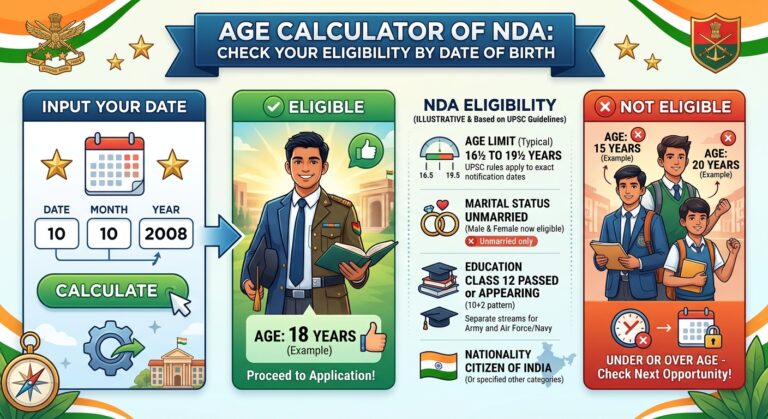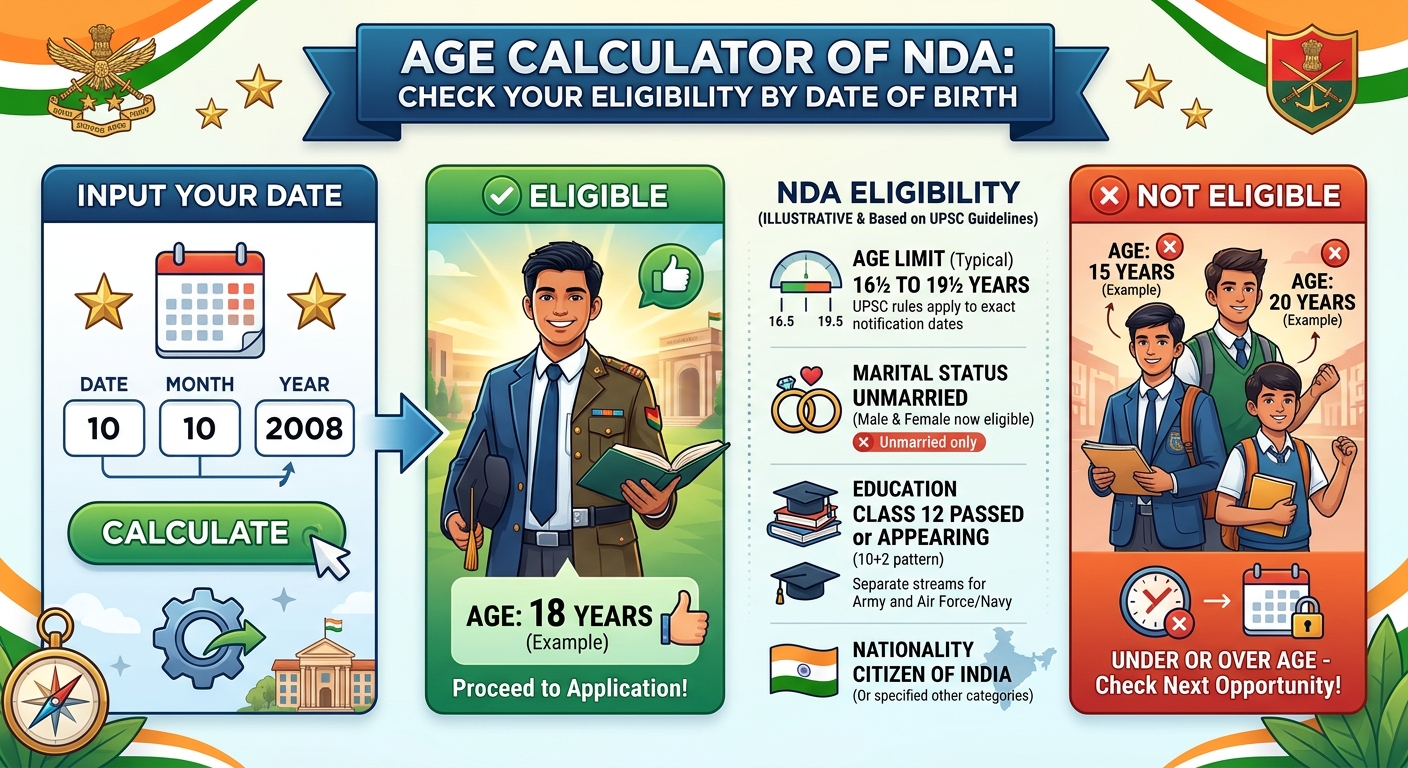
One of the first questions most people ask when looking to apply to the NDA is whether they are too old or if they’re even old enough. This can be answered by looking at your date of birth, and it can be done within a matter of minutes.
This guide will tell you everything you need to know about the age calculator of nda. It’ll show you how to work out if you’re eligible by hand. We’ll also help you avoid common mistakes. This acts as an age calculator for the NDA exam.
What the NDA Age Rule Actually Says
The National Defence Academy and Naval Academy Examination is conducted by UPSC twice a year. However, instead of an age range being given, UPSC states the acceptable range of dates you could have been born on. If you were born between the start and finish of this range, you will be eligible.
This will always be a period of 3 years. This means essentially that you will be eligible if you are aged around 16.5 years old and under, and 19.5 years old and over when the course begins.
There are two key things that you should take note of:
- The range is based around specific dates.
- For each exam, the range will move forward by 6 months. So this could mean that if you were eligible this time, you might not be eligible next time. Alternatively, if you were not eligible this time, you might be eligible next time.
Recent Example Windows
The table below shows how the window shifts between cycles. I have included the pattern as an illustration so you can see the logic. The dates for any specific exam must be confirmed from the official UPSC notification, since UPSC publishes them each cycle.
| Exam cycle | Born not earlier than | Born not later than |
| NDA I 2026 | 2 July 2007 | 1 July 2010 |
| NDA II 2026 (pattern-based) | 2 January 2008 | 1 January 2011 |
| NDA I 2027 (pattern-based) | 2 July 2008 | 1 July 2011 |
Notice that each row starts exactly six months after the previous one. That regularity is what lets you estimate your eligibility well in advance. Still, treat the pattern-based rows as an estimate and verify them once the notification is out. NDA I notifications typically appear around the end of the year.
How to Calculate NDA Age Eligibility Step by Step
You don’t need any formulas. Just 2 dates and some comparison.
Step 1: Determine the date window. Go to the latest UPSC notification for NDA and note down the date of “born not earlier than” and “born not later than”.
Step 2: Note the date of birth mentioned on your Matriculation/Secondary School certificate. This will be considered as proof by UPSC.
Step 3: Compare your date of birth with the above-mentioned dates.
- Is your date of birth equal or greater than the start date?
- Is your date of birth equal to or earlier than the end date?
If both answers are yes, then you fulfill the age criteria. Otherwise, you don’t.
Worked Examples
Using the NDA I 2026 window (2 July 2007 to 1 July 2010):
- Born 15 March 2008.This falls inside the window. Eligible by age.
- Born 1 July 2007.This is one day before the start date. Not eligible for this cycle, even though the gap is a single day.
- Born 2 July 2007.This is exactly the start date. Eligible.
- Born 1 July 2010.This is exactly the end date. Eligible.
- Born 2 July 2010.This is one day past the end date. Not eligible for this cycle, but this candidate will likely qualify in a later one.
The last example matters more than it looks. Being “too young” is not a rejection, only a delay. A candidate born on 2 July 2010 simply becomes eligible when the window shifts.
Why One Day Can Decide Everything
The UPSC is very strict about cutoff dates. So there is no concept of giving some leeway/rounding off as regards the NDA age limit. One day more/less will be treated the same as 2 years more/less.
Thus, you must be very careful with the cut-off dates. If your DOB falls close to either end (within a few days), you must verify your certificate again, recalculate the dates, and match them with the wording given in the notification. Do not depend on memory or a summary from a coaching centre.
How Many Attempts Does the Age Window Give You?
Considering the duration of the window is 3 years, and the changes happen every 6 months, any candidate has approximately 6 consecutive exam cycles to take the exam. However, most of the candidates do not get the opportunity to utilise all the available exam cycles due to the educational phase.
As a student of class 12th, you can appear for the exam if you are appearing for the qualifying exam. Hence, most of the aspirants choose to give their first attempt just after finishing their studies. In case you miss one cycle, you can generally give the next cycle, as your DOB will still fall in the changing window.
However, if your DOB is towards the higher end of the window, you might have only 1 or 2 exam cycles left. So you need to plan well for your preparation.
Other Eligibility Conditions Beyond Age
Now we need to make sure that you have met the age criteria. Also ensure that:
- Marital Status– Single (Unmarried) candidates only.
- Nationality – Citizens of India will be eligible to apply. Some categories will also be eligible (as mentioned in the notification). For example, candidates belonging to the subjects of Nepal & Bhutan. Please check the exact wording given in the notification every year.
- Army Wing– Pass out from class 12th or equivalent in any stream.
- Air Force & Naval Wings and 10+2 Cadet Entry Scheme (Indian Naval Academy)– Pass out from Class 12th with Physics & Maths.
- Physical and Medical Criteria– Will be checked during later stages.
These educational criteria can change between notifications, and the list of eligible categories can also vary. So this is just a guide; please ensure you are on the correct list!
Common Mistakes to Avoid
Using the exam date to count your age. The NDA does not ask “how old are you on exam day.” It asks whether your birth date sits inside the window. Counting years from the exam date produces wrong answers near the edges.
Trusting an age that differs from your certificate. If your Aadhaar, passport, or school records show different dates of birth, UPSC goes by the matriculation or equivalent certificate. Apply using that date. Fixing a discrepancy takes time with the school board, so sort it out well before the form opens.
Assuming last year’s dates still apply. The window shifts every cycle. A friend’s eligibility from last year tells you nothing about yours.
Waiting until the last week of applications. If you find an age or document problem on the final day, there is nothing you can do about it. Check eligibility the moment the notification is released.
Relying on unofficial websites for the final decision. Blogs and calculators, including this one, are useful for planning. The official notification is the only source that counts.
A Simple Planning Habit That Helps
If you are in Class 10 or 11 and thinking about NDA, work backwards from your date of birth instead of waiting for each notification. Add 16.5 years to your birth date to find roughly when you first become eligible, and add 19.5 years to find when your last chance ends. Then mark the corresponding exam cycles on a calendar.
For example, someone born on 20 October 2008 reaches about 16.5 years in April 2025 and 19.5 years in April 2028. That gives a rough sense of which cycles to target, which is far more useful than a vague feeling of “I have time.” The final dates will still come from the UPSC notification, but this estimate tells you whether you are looking at six comfortable attempts or only two.
Pros and Cons of Using an Online Age Calculator
Pros
- Fast, especially if you are comparing several family members or friends.
- Removes arithmetic slips with month lengths and leap years.
Cons
- It is only as accurate as the window dates built into it, which may be outdated.
- It cannot verify your certificate, marital status, or education requirements.
A good habit is to use any calculator as a first filter, then confirm manually against the notification. The manual method in this article takes less than a minute, so you lose nothing by doing both.
Final Thought
The age calculator of nda rule is simple once you see it for what it is: a pair of dates, not a number. Your date of birth either sits inside the window or it does not, and the window moves every six months. That is good news for anyone who feels “too young” or worries they have “missed their chance,” because the calendar often works in your favour more than you expect.
Frequently Asked Questions
Can girls apply for NDA?
Yes. Unmarried women are eligible to apply under the same age window and educational conditions.
Is there age relaxation for any category?
The NDA age window is generally applied strictly, without the relaxations seen in some other government exams. Check the current notification for any exception.
What if my date of birth is wrong in my school certificate?
You will need to correct it through the issuing board before applying. UPSC relies on that certificate, so a mismatch can create problems at document verification.
Can I apply while still in Class 12?
Yes, candidates appearing in the qualifying examination can apply, subject to producing proof of passing within the timeline stated in the notification.
Does the age limit differ for Army, Navy and Air Force?
The date of birth window is common for the examination. The educational requirements are what differ between wings.
About the Author