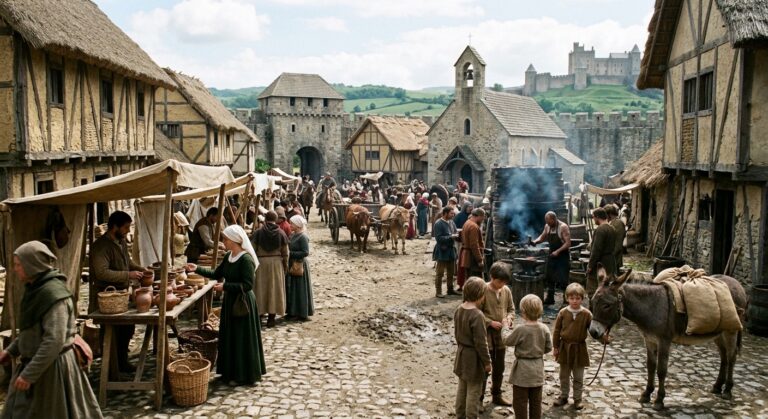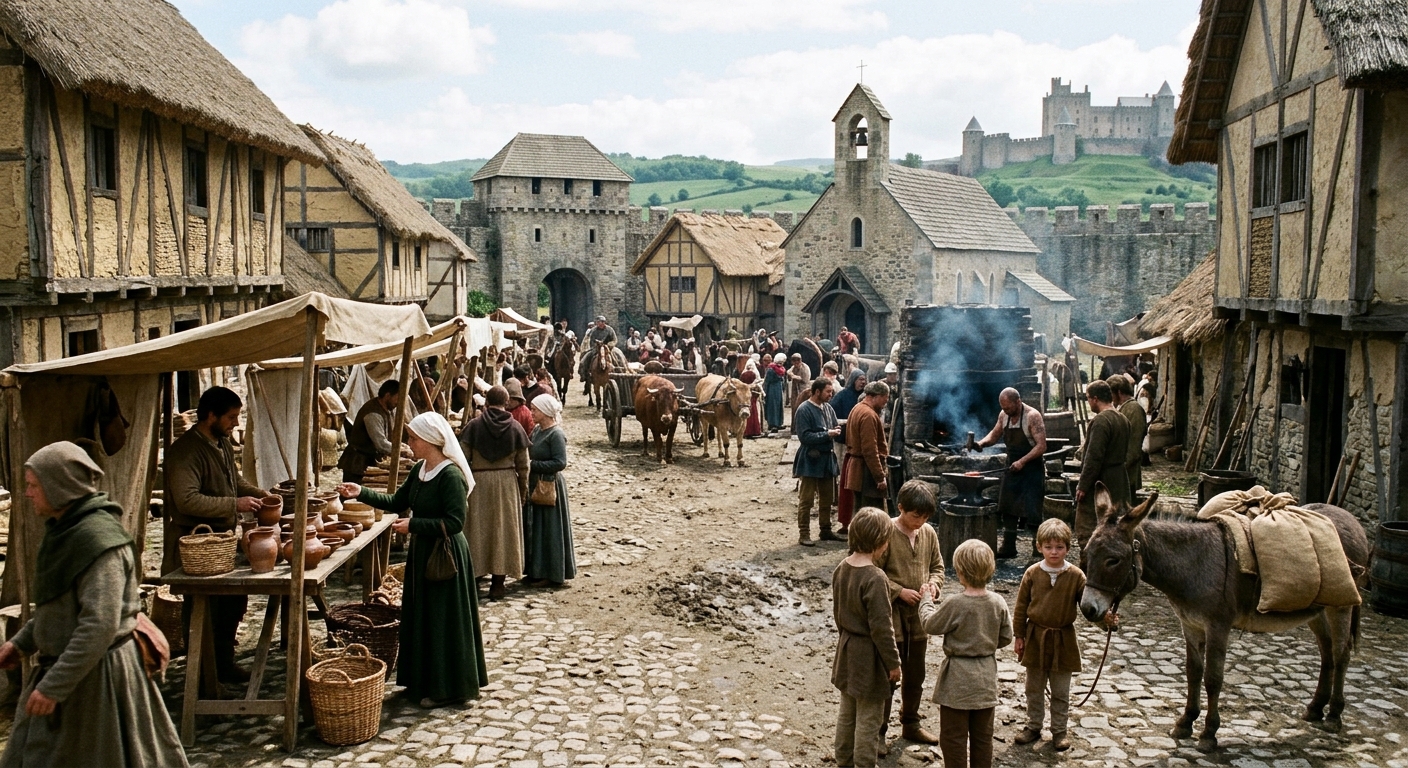
Many people will think of the Middle Ages as a time of knights, castles, plagues, and mud. Whilst some of this is true, much of our perception comes from a long period of time when people have tried to create a caricature of this period to compare to their times.
The Middle Ages cover around 1000 years of European history. During this period, society changed dramatically. The life of a farmer in 600 would have been very different to the life of a wool merchant in 1400. This guide will give you the definition, time period, main events, and an accurate picture of what life was like during this time. You’ll be left with a framework to work with!
Middle Ages Definition: What the Term Actually Means
The Middle Ages were an era in European history. The word itself indicates there was some bias at the time, as it was seen by 14th– and 15th-century Italian Scholars who admired Ancient Greece and Rome that their time was an age of renewal of the classical era. The ‘middle’ comes from when they saw themselves as being stuck between two ages, which they viewed as better.
Today, the Middle Ages are used as a convenient term. Medieval and Middle Ages are synonymous. Both words originate from Latin and mean middle age.
This term is Eurocentric. It refers to European history. While many places experienced times of change (Islamic Golden Age, Tang and Song dynasties in China, Great West African Empires of Ghana and Mali), the term medieval is occasionally used. This does, however, cause confusion about how different these times were.
When Was the Medieval Period?
The dates people often ask about when was the medieval period are usually asking for specific years. Unfortunately, there aren’t really any clear dates, as these historical periods overlap. However, it is commonly accepted that the medieval period started:
- Around 476 CE with the deposition of the last Western Roman emperor, Romulus Augustulus. Some historians prefer to see the change as a more fluid event between the 3rd and 7th centuries.
- And ended sometime around 1453 (the fall of Constantinople to the Ottomans), or 1492 (Columbus’ first voyage). Some say it ended with the protestant reformation in 1517, or simply that the 15th century was a slow transition.
Historians usually divide the period into three phases:
| Phase | Approximate dates | General character |
| Early Middle Ages | 500 to 1000 | Collapse of Roman administration, rise of new kingdoms, spread of Christianity, Viking and other raids |
| High Middle Ages | 1000 to 1300 | Population growth, expanding trade, towns and universities, cathedral building, the Crusades |
| Late Middle Ages | 1300 to 1500 | Famine, the Black Death, the Hundred Years’ War, political upheaval, early signs of the Renaissance |
This division is useful because “medieval” is not one uniform thing. Treat the three phases as three different eras and most common misunderstandings disappear.
When Were the Dark Ages, and Were They Really Dark?
When people search for the Dark Ages, they usually refer to the early ages between c. 500- c. 1000. However, the term ‘Dark Ages’ was originally coined by the Italian poet Petrarch. It really meant ‘poorly documented’ times and that there wasn’t the literary culture that the Romans had. It didn’t mean it was a violent and ignorant time.
Most historians nowadays try to avoid using the term because:
- It doesn’t mean that there was no civilisation. There were simply fewer written records from certain areas and decades, making it harder to investigate.
- There were many achievements. Monks were copying texts and preserving them. There were amazing pieces of work created by the Irish and Anglo-Saxons, such as the Book of Kells and the Lindisfarne Gospels. There was also a renaissance with Charlemagne’s court.
- Technological advancements were still happening. The introduction of heavy ploughs, water mills and horse collars helped increase agriculture.
- The term doesn’t take into account the rest of the world. Baghdad, Córdoba and Constantinople were big centres of science, medicine and learning in these centuries.
However, it would be incorrect to say that there wasn’t any loss. With the collapse of the Roman Western government, trade over long distances decreased. Cities in many areas had a loss in population. Literacy only existed in the church. Often life was more localised and uncertain. An accurate summary would be that there were definite disruptions during the early period, but there was also continuity and innovation.
If you see the phrase during the Dark Ages in a book or video, it is just a general term for the early medieval centuries. If any source uses the term to suggest everything declined, then be cautious.
Medieval Europe: How Society Was Organized
Feudalism and the Manor
In medieval Europe, much of the population was farmers, and land ownership was at the centre of power. Many areas had a system in place known as feudalism. Kings would give land to nobles for them to fight for them. The nobles would then pass on some of their land to lesser lords and knights. The peasants formed the bottom of the pyramid.
Some historians have debated how accurate this system was. As it changed a lot depending on area and time period, some historians argue that there was no such thing as feudalism and that it is a nice word for something complicated.
Most manors had peasants working on their own strips of land and the lord’s land. Many of these peasants were serfs, meaning they were tied to the land and had to work or pay for the lord. However, there were also free peasants. Depending on the area and century, the number of free peasants varied.
The 3 Orders
Many medieval writers often divided society into 3 groups. Those who prayed (The Clergy), those who fought (The Nobles), and those who worked (The Peasants). This was an ideal view and did not take into account merchants, craftsmen, townspeople, or the many roles of women. These people became more prominent over time.
The Church
The church was the most influential institution in medieval Europe. It ran schools and hospitals, owned huge amounts of land, and kept records of births and deaths. They also influenced the calendar with feast days. Although a village priest, wandering friar, and powerful bishop all belong to the same organisation, their lives would be very different.
Daily Life in Medieval Times
Peasants
Most people were peasants. They lived a life dictated by the seasons. They would have had to plough and sow, make hay, harvest and then thresh. They would have eaten a simple diet based around bread, pottage (porridge made with grains and vegetables), ale, and whatever fruit/vegetables were in season. Some meat might have been eaten occasionally. The houses were usually small, with timber and wattle and daub or stone depending on the area. The house would be built around a central hearth.
They would have had a tough life, but they did have many holy days throughout the year according to the Church calendar. This meant they had many days off where they could celebrate, play games, and come together as a community.
Townsmen/Merchants
Towns started to grow from the 11th century. Craftsmen would join together in guilds. These would set standards, train apprentices, and look out for their members. Fairs were set up to trade goods, such as the ones in Champagne. Cities like Venice, Bruges and Florence became rich due to trading and banking.
Nobles/Knights
The nobles would have had a life focused around land, law, politics and war. Castles were initially built as a practical place for military and administration. Many castles were far from the fairy-tale image and were quite harsh. Knighthood involved military training, and the idea of chivalry was slowly developing. In reality, it was often not treated equally.
Women
Depending on their class, women would have had a different life. Peasants would have worked in the fields, brewed ale and looked after the home. Towns women might have run a business or had a trade but were often restricted by the guilds. Nobles could have run the estate whilst their husbands were away. Women who went into convents could become educated and have power that they wouldn’t have elsewhere. For example, Hildegard of Bingen was an abbess, composer, and writer in the 12 th century. Generally, women wouldn’t have many legal rights compared to men.
Key Events That Shaped the Period
Although you don’t have to learn every date, knowing these key points will help you form a basic understanding.
- 800 – Charlemagne was crowned emperor in Rome, showing a new political order in Western Europe.
- 793 onwards – The Vikings began raiding, leading to Norse settlement and trade, changing Europe.
- 1066 – William of Normandy conquered England, changing its language, legal system, and elite.
- 1095-1291 – The Crusades led to a long-lasting relationship with conflict between Europe and the Middle East.
- 1215 – The Magna Carta limited the power of the king in England. This was a significant step towards constitutionalism but had little impact in the short term.
- 1347-1351 – The black death hit Europe.
- 1337-1453 – The Hundred Years’ War changed both England and France.
- c. 1450 – Johannes Gutenberg developed movable-type printing in Europe, speeding up the spread of ideas.
The Black Death and Its Consequences
The Black Death hit Europe during the late 1340s and wiped out a huge proportion of the population. It is difficult to find an accurate figure of how many died during this time; however, many scholars suggest that roughly 1/3 of the population of Europe died. However, this will vary depending on the area.
In the long term, this caused a rise in the value of labour due to fewer workers being available. Wages rose in some parts of Western Europe, causing a decline in serfdom. Landlords were often against this change, causing problems such as the English Peasants’ Revolt of 1381. The plague also had an impact on religious beliefs, art, and views on authority.
Common Myths About the Middle Ages
Here are corrections to a few widely repeated ideas:
- “People believed the Earth was flat.” Educated medieval Europeans generally knew the Earth was a sphere. This idea was inherited from ancient Greek scholarship.
- “Everyone was filthy.” Public baths existed in many towns, and washing was common, though standards and access varied.
- “There was no science or innovation.” Medieval universities at Bologna, Paris, and Oxford developed rigorous methods of argument, and inventions like eyeglasses, mechanical clocks, and improved agricultural tools emerged.
- “Everyone died young.” Average life expectancy at birth was low mainly because of high infant and child mortality. People who survived childhood often lived into their 50s, 60s, and beyond.
- “Medieval armies were all knights in full plate armor.” Full plate armor belongs mostly to the late medieval period, and armies relied heavily on foot soldiers and archers.
Key Takeaways
- From approximately 476 to 1500. There is no hard and fast date, but it is best split into three parts.
- Early Middle Ages, High Middle Ages and Late Middle Ages.
- Although the term ‘Dark Ages’ is now outdated (for most historians), there was certainly a lot going on during the early part of the Middle Ages.
- Europe was very varied, and people of different classes, genders, and regions had different experiences.
- Changes such as the Black Death and expansion of towns meant that society changed completely.
Final Thoughts
With the concept of the Middle Ages broken up, it becomes much easier to understand the times. In around one thousand years, Europe changed from being divided into many parts after the Romans to having Universities, trading cities, and new nations. This period saw the rise of cathedrals, plague pits, learning and superstition, strict hierarchies, and slowly breaking down hierarchies.
Frequently Asked Questions About the Middle Ages
What are the Middle Ages?
The Middle Ages are the time between the end of the Western Roman Empire and the beginning of the modern age. This is usually taken to be between 476 and 1500. They are also known as the medieval period.
When was the medieval period?
Traditionally, the medieval period has been seen as starting around 476CE and ending around 1453 or 1500. However, because the changes in society were slow, there are no definite times to mark the start and end of this period. Different areas will have different dates.
When were the Dark Ages?
The Dark Ages is a term commonly given to the early medieval centuries (c. 5 th to 10th century). However, most historians nowadays do not use this term as it makes the era seem worse than it really was. There were actual moments of cultural and technological advancement.
Why are they called the Middle Ages?
During the Renaissance period, scholars named the centuries between classical antiquity and their time the “Middle Ages”.
What was medieval Europe like?
Medieval Europe was mostly a rural and agricultural society. It was divided into landowners, local lords, and the Church. Eventually, towns were created along with trade, universities, and more powerful kings, meaning that the 8th century would look very different from the 14th century.
About the Author