
The concept of “neuroplasticity” was once a fringe scientific theory, but today it is the cornerstone of modern educational psychology. For decades, we believed the adult brain was a static organ—fixed in its ways and limited in its capacity to learn new tricks after a certain age. However, recent breakthroughs in neuroscience have proven that your brain is more like plastic than a stone. It is a dynamic, living system that physically reshapes itself in response to every new thought, skill, and environment. When we talk about “re-wiring” the brain to study faster, we aren’t just using a metaphor; we are talking about the literal thickening of neural pathways and the optimization of synaptic firing through deliberate practice.
The challenge most college students face is that their current study habits are actually wiring their brains for distraction rather than focus. Constant multitasking and high-stress environments lead to the weakening of executive function. To reverse this, you must engage in deliberate cognitive restructuring. For instance, when you decide to buy expository essay services from myassignmenthelp, you aren’t just offloading a task; you are strategically managing your cognitive load so your brain can focus on mastering the core concepts of your major rather than getting bogged down in repetitive formatting. By delegating high-volume tasks, you create the mental space required for “Deep Work,” which is the only state where true neural re-wiring occurs and complex information becomes permanent knowledge.
The Biology of Accelerated Learning: Myelination and BDNF
To understand how to study faster, you have to understand the physical infrastructure of your thoughts. Your brain contains approximately 86 billion neurons, but the speed of your learning isn’t determined by the number of neurons; it’s determined by the strength of the connections between them. This involves a process called Myelination.
Think of your neurons as electrical wires. Myelin is the fatty insulation wrapped around those wires. The more you practice a specific skill or recall a specific piece of information, the thicker that insulation becomes. This process allows electrical impulses to travel up to 100 times faster, turning a slow, conscious effort into a fast, subconscious reflex.
Another key player in this biological upgrade is Brain-Derived Neurotrophic Factor (BDNF). Often called “Miracle-Gro for the brain,” BDNF is a protein that supports the survival of existing neurons and encourages the growth of new ones. When you engage in high-intensity learning or aerobic exercise, your BDNF levels spike. This creates a “neuroplastic window” where your brain is primed to absorb information at an accelerated rate. If you study during this window, you are essentially building a high-speed fiber-optic network in your prefrontal cortex.
The Role of Synaptic Pruning
Your brain is a master of efficiency. It constantly performs a “cleanup” operation called synaptic pruning. If you don’t use a neural pathway, the brain “prunes” it to save energy for more frequent activities. This is why “cramming” for an exam fails in the long run. The brain views that information as a one-time event and doesn’t invest the energy to build lasting structures. To re-wire effectively, you must signal to your brain that the information is a permanent necessity.
Active Recall: The “Cheat Code” for Neural Pathways
If you want to re-wire your brain to learn faster, you must move away from “passive review.” Highlighting textbooks and re-reading notes are the least effective ways to study because they don’t force the brain to do any heavy lifting. They create an “illusion of competence”—you feel like you know the material because it looks familiar, but your brain hasn’t actually built the retrieval path. Instead, you need Active Recall.
Active recall is the process of forcing your brain to retrieve information from memory without looking at your notes. Every time you struggle to remember a fact, you are strengthening the neural “bridge” to that information. It’s the mental equivalent of lifting weights. The harder the struggle, the stronger the connection becomes.
Comparison of Learning Methods
| Method | Biological Impact | Retention Rate | Efficiency |
| Passive Re-reading | Low synaptic engagement | 5-10% | Very Low |
| Highlighting | Visual recognition only | 10-15% | Low |
| Active Recall | Strengthens neural retrieval paths | 70-80% | High |
| Spaced Repetition | Prevents synaptic pruning | 90% | Maximum |
Managing Cognitive Load and Academic Stress
One of the biggest obstacles to neuroplasticity is Cortisol, the primary stress hormone. When you are overwhelmed by a mountain of deadlines, your body enters “survival mode.” In this state, the brain shuts down the prefrontal cortex—the area responsible for logic, critical thinking, and complex learning—to save energy for the “fight or flight” response. This is why students often feel “frozen” or experience “brain fog” when looking at a massive dissertation or a complex lab report.
Breaking down these massive tasks is essential for maintaining a healthy “learning state.” For example, knowing how to write an APA abstract is a foundational skill, yet many students find the technicalities of citation and formatting so stressful that it triggers a cortisol spike, blocking their ability to actually learn the subject matter. To combat this, smart students use structured templates and professional research tools to streamline the technical side of their work. By removing the friction of formatting, you allow your brain to stay in the “Alpha” state—the brainwave state associated with relaxed alertness and high creativity.
The Circadian Rhythm of Knowledge
Your brain does not stay in a “learning state” 24/7. It operates on ultradian and circadian rhythms. For most people, the prefrontal cortex is most active about 2–4 hours after waking up. This is your “Peak Cognitive Window.” If you use this time to answer emails or scroll social media, you are wasting your brain’s best re-wiring time on trivial tasks.
The Glymphatic System: Why Sleep is Non-Negotiable
You don’t actually “learn” while you are awake; you only “input” data. The physical re-wiring of the brain—the actual building of myelin and the consolidation of memory from short-term to long-term storage—happens while you sleep. The Glymphatic System acts as a waste clearance system, flushing out metabolic toxins (like amyloid-beta) that build up during the day.
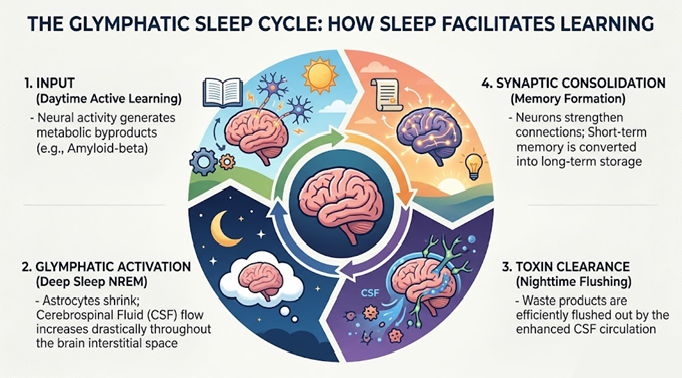
Without 7–9 hours of sleep, your brain is like a cluttered desk; there’s no room to lay down new neural tracks. Research shows that sleep-deprived students have significantly less “plasticity” in their hippocampus, making it nearly impossible to retain new information regardless of how hard they study.
Dopamine Detox: Training Your Focus for 2026
In the modern digital landscape, the biggest threat to your GPA isn’t a lack of intelligence; it’s a lack of focus. Our brains are currently wired for “micro-hits” of dopamine from notifications and short-form videos. This has shortened our collective attention span and weakened our “Deep Work” muscles. When you check your phone every 10 minutes, you are actually “re-wiring” your brain to be distracted.
To re-wire your brain for faster studying, you must perform a Dopamine Detox. This involves training your brain to tolerate boredom and sustain attention.
- Mono-tasking: Focusing on one single subject for 60-90 minutes.
- The 20-Minute Rule: It takes the brain an average of 23 minutes to fully refocus after a single interruption. If you check a text, you lose nearly half an hour of “prime” learning time.
- Environmental Cues: Have a dedicated study space. When you enter that space, your brain should automatically trigger a “Focus Mode” through associative learning.
Semantic Clustering: Learning by Association
Your brain doesn’t store information in a vacuum; it stores it in “clusters.” This is why it’s easier to remember things when they are part of a story or a logical map. This is known as Semantic Clustering.
Instead of memorizing isolated facts, try to find the “Topical Authority” of a subject. How does one concept lead to another? When you build a mental map, you are creating multiple “entry points” to a single memory. If you forget one detail, your brain can follow a different path in the cluster to retrieve it. This is the secret to “Accelerated Learning”—it’s not about memorizing more, it’s about connecting more.
Practical Steps to “Re-Wire” Today
If you want to start studying faster immediately, follow this protocol:
- High-Intensity Interval Learning (Pomodoro 2.0): Study for 50 minutes of deep focus, then take a 10-minute break. During the break, do not look at a screen. Walk, stretch, or stare out a window. This allows for “offline consolidation.”
- The Feynman Technique: Try to explain a complex concept to a 12-year-old. If you can’t explain it simply, your neural connections aren’t strong enough yet. Identifying the gaps in your explanation tells you exactly where you need more “myelin.”
- Optimize Your Nutrition: Your brain is 60% fat. Omega-3 fatty acids and antioxidants are the raw materials your brain needs to build new synapses and protect existing ones from oxidative stress.
- Strategic Outsourcing: Don’t let administrative academic tasks burn you out. Use professional support for formatting, proofreading, and data gathering so you can spend your “Brain Wealth” on the actual learning. Managing your energy is just as important as managing your time.
Conclusion: The Plastic Mind
You are not stuck with the brain you were born with, nor the one you had yesterday. By understanding the biological mechanics of myelination, BDNF, and the glymphatic system, you can consciously design a brain that absorbs information faster and retains it longer.
The secret to academic success isn’t “trying harder”—it’s studying smarter by working with your biology instead of against it. When you remove the friction of stress and the distraction of low-value tasks, you unlock a level of cognitive performance that most people think is reserved for geniuses. Your brain is ready to change; you just have to give it the right environment and the right tools to do so. High-quality research and expert-level assistance aren’t just shortcuts; they are strategic tools in a high-performer’s arsenal to maintain the mental clarity needed for true mastery.
Frequently Asked Questions
Can anyone really change their brain’s learning capacity?
Yes. Through a process called neuroplasticity, the brain physically reorganizes itself by strengthening frequently used neural pathways. By adopting specific study habits like active recall and spaced repetition, you can increase the speed and efficiency with which your brain processes and retains new information.
How does sleep affect the ability to study faster?
Sleep is essential for memory consolidation. During rest, the glymphatic system clears out metabolic waste while the brain moves information from short-term to long-term storage. Without adequate sleep, the neural connections required for learning cannot be properly solidified, regardless of how much you study.
Why is active recall better than re-reading notes?
Re-reading creates a false sense of familiarity known as the “recognition heuristic.” Active recall, however, forces the brain to retrieve information from scratch, which strengthens the synaptic connections and builds a more durable “pathway” to that memory, making it easier to access during exams.
What role does stress play in the learning process?
Chronic stress triggers the release of cortisol, which can temporarily shut down the prefrontal cortex—the area responsible for logical thinking and complex problem-solving. Managing your workload and reducing academic pressure allows the brain to remain in a state of relaxed alertness, which is optimal for neuroplasticity.
About The Author
Alice Anderson is a seasoned academic strategist and senior researcher at myassignmenthelp, where she specializes in bridging the gap between complex cognitive science and practical student success. With over a decade of experience in educational psychology, Alice focuses on empowering learners to optimize their study workflows and achieve peak academic performance.
About the Author